
First direction, then AI. Technical asset management as the missing link
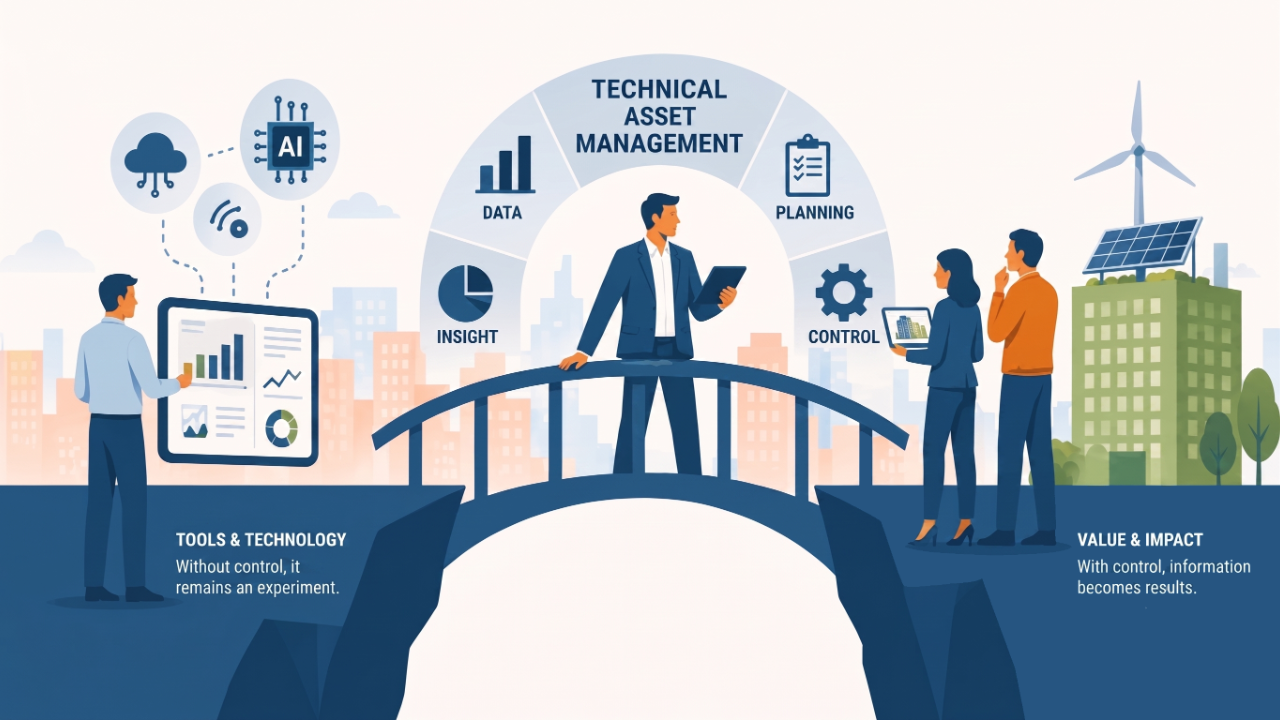
Real estate owners are investing in AI tools, sensors, and dashboards in the hope of improving their portfolio performance. In practice, what makes the difference is a discipline that operates more structurally than any tool: information-driven technical asset management (TAM). This involves continuous control over a building's performance, using information as a steering mechanism and an identifiable party authorized to make decisions based on that information.
In January, we already wrote that AI in real estate only becomes valuable once the foundation is in order. Four months later, the question has become more concrete: what exactly is that foundation? The answer lies less with software and more with the discipline that forms the basis.
GACS reveals the difference
The difference between having and not having TAM became visible this year around GACS. Since the mandatory requirement for non-residential buildings above 290 kW came into effect on January 1st, it has become visible in the market what the checkers are and what the controllers are. The checkers have a system that simply generates data. The controllers use that data to adjust installations, explain consumption, and substantiate investment decisions. The difference therefore lies primarily in the surrounding discipline. Who receives the data, who interprets it, and who is authorized to decide that an installation needs to be adjusted or replaced? In Zandkasteel Amsterdam, we saw this difference in concrete terms: thanks to Blue Module's approach, consumption dropped from 2.7 to 1.4 million kWh per year. Not because a single AI tool was installed, but because data, technical asset management, and ownership began to function as a single entity.
The reverse is also true
Conversely, TAM also requires a reliable information layer. Without the right data, decisions are quickly made without proper substantiation, resulting in fragmented requests to installers. This is precisely what parties like MYSS, Blue Module's TAM partner, encounter in portfolios where management is historically fragmented. The technical knowledge is there, but what is missing is the data to feed that knowledge in a timely and structured manner. Both sides must be up to standard: the data and the governance. From point solution to management
Owners who are now getting both their TAM and their information layer in order will soon have the freedom to invest specifically in point solutions: AI, sensing, a tenant community, a new EMS. With TAM, you know which solution adds value to what the foundation already delivers in which building.
That is a different conversation than the one many owners are currently having with technical parties, each presenting their own tool as the best. Without management, every new solution remains an experiment that rarely yields results for operations.
